
The Window is Always Moving
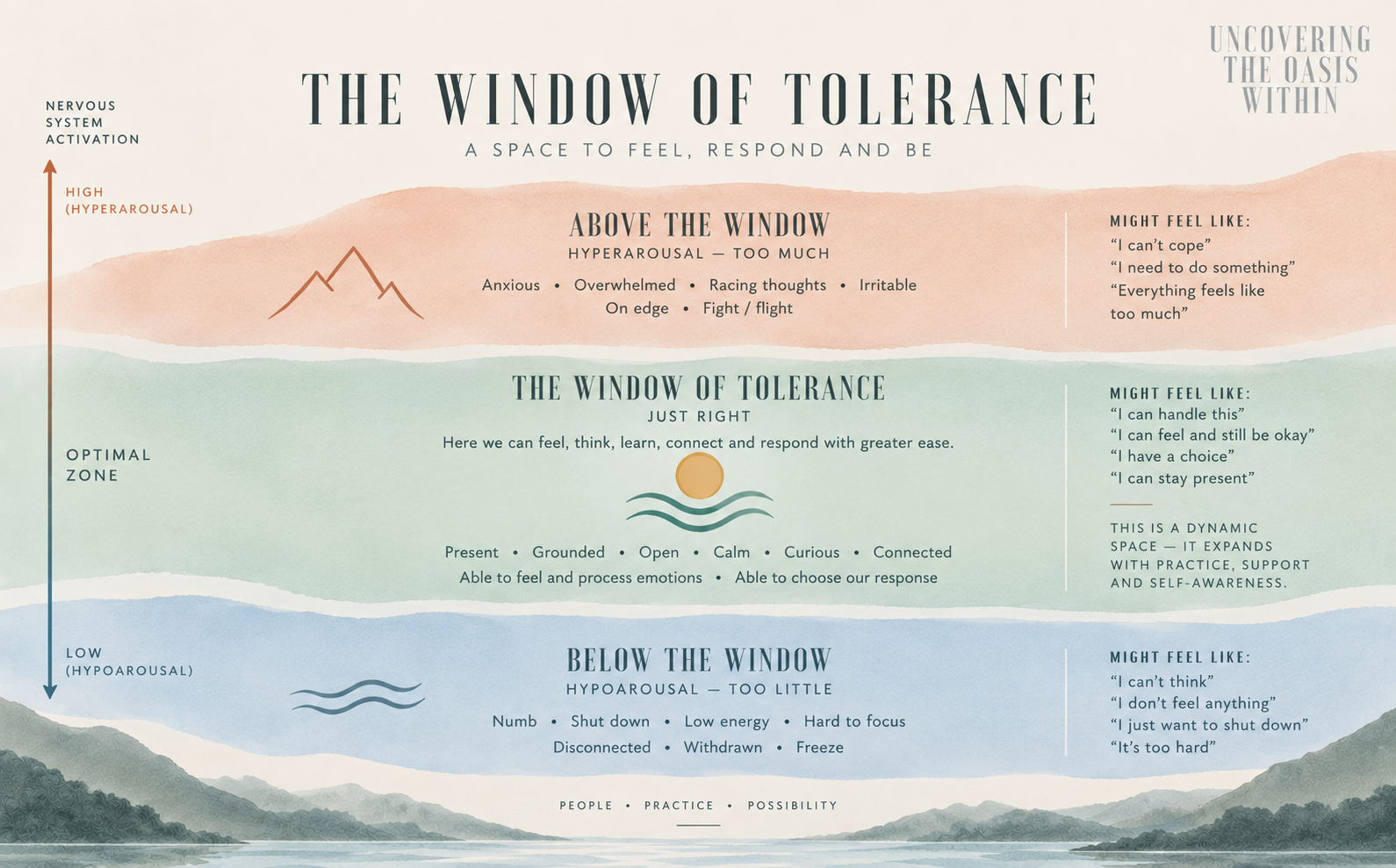
One of the most helpful things I have learnt about the Window of Tolerance is that it is not a fixed measure of how well we cope with life.
Our window is dynamic.
The Window of Tolerance describes the range of nervous-system activation within which we can remain present, think clearly, process emotions and respond to what is happening with some degree of choice. When activation becomes too high, we may move towards hyperarousal—anxiety, irritability, overwhelm or fight-or-flight. When activation falls too low, we may experience hypoarousal—numbness, disconnection, exhaustion or shutdown.
But the boundaries of this window are continually shifting.
Something we navigate with relative ease one day might feel overwhelming on another. This does not necessarily mean we have become less resilient. It may simply mean that the resources available to us have changed.
I find it helpful to consider five factors that can shape our relationship with stress activation: our body, environment, relationships, past experiences and available resources.
Our body matters. Sleep, nourishment, illness, hormonal changes, physical exhaustion and accumulated stress can all influence how much capacity we have available. After several nights of poor sleep, the email that would ordinarily be mildly irritating might suddenly feel enormous.
Our environment matters too. Noise, crowds, uncertainty, relentless stimulation or a lack of privacy can place additional demands on the nervous system. Conversely, environments that feel predictable, familiar and supportive may make regulation easier.
Our relationships can shift our window in either direction. Human beings regulate in relationship with one another. Feeling heard, supported and safe in someone's presence can help us settle. Conflict, disconnection or unpredictability can increase activation. This is one reason co-regulation can be such an important part of wellbeing.
Our past experiences also shape how the nervous system interprets the present. Sometimes our response appears disproportionate to what is happening now because something about the experience carries familiarity. The nervous system is not simply responding to the event; it may also be drawing upon what it has learnt previously about threat and safety.
Finally, there are our available resources—the internal and external supports we can draw upon. Breath, movement, mindfulness, rest, boundaries, supportive relationships, therapy, time in nature and practices such as yoga can all contribute to our capacity to meet activation without immediately becoming overwhelmed by it.
For me, this is where understanding the Window of Tolerance becomes empowering.
The goal is not to remain perfectly regulated at all times. Stress activation is part of being human, and moving outside our window is not a failure.
Instead, we can become curious.
What might be shaping my window today? What resources do I have available? What might I need more—or less—of right now?
When we understand that our window is dynamic, perhaps we can meet ourselves with less judgement and greater compassion.
And over time, through awareness, support and practice, we may discover that our capacity to meet life's inevitable waves can change too.
“Where attention goes, neural firing flows, and neural connection grows.” — Daniel J. Siegel